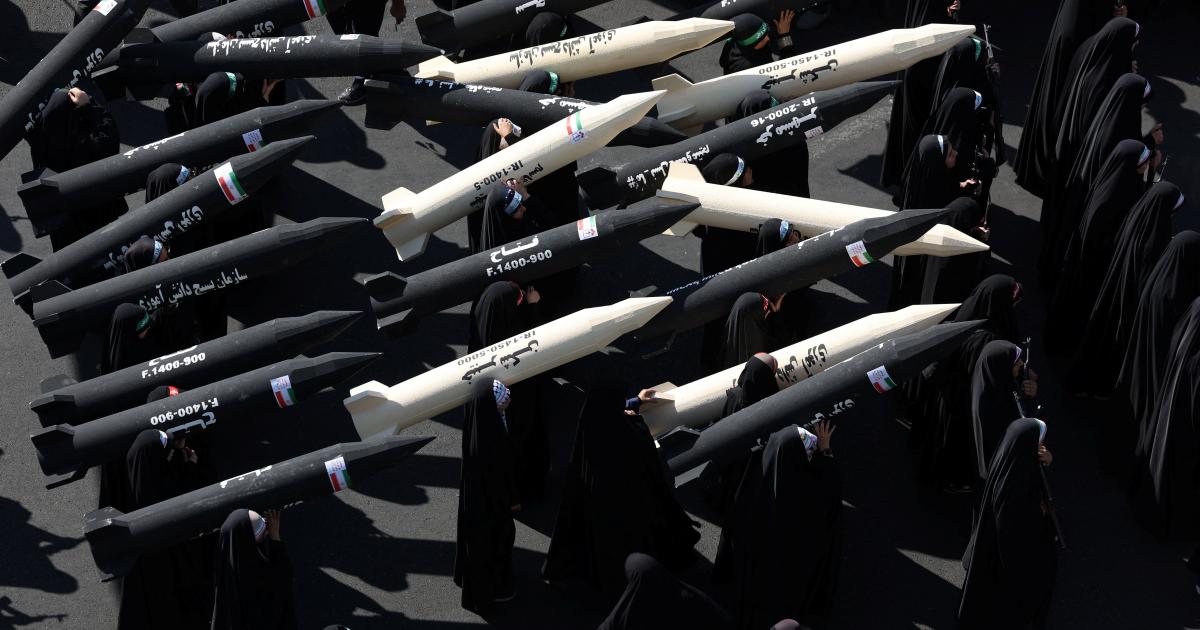
Who Needs the Bomb?
Preventing the Worst
Eric S. Edelman and Franklin C. Miller
Reports of the death of nuclear deterrence are greatly exaggerated. Obituaries for nuclear weapons simply misapprehend the role these arms have played since 1945.
Read more America in Decay
In “The Strange Defeat of Nuclear Deterrence” (July/August 2026), Rose Gottemoeller insists that nuclear weapons increasingly lack value and purpose. She argues that nuclear deterrence “is not working,” that “the possibility of nuclear escalation and retribution did not prevent conventional and hybrid war,” and that the U.S. nuclear triad of intercontinental ballistic missiles, nuclear submarines, and strategic bomber aircraft “can do little to deter salvos of cheap drones.” She points to a number of recent examples to support this observation, including Ukraine’s successful attacks on Russian strategic bomber bases despite Russian doctrine stating that “a conventional attack on its strategic assets could provoke a nuclear response,” Iran’s attacks on Israel, and dangerous clashes between nucleararmed rivals India and Pakistan.
These cases certainly show instances in which the possession of nuclear weapons has failed to deter the escalation of conventional conflict. At the same time, they represent a misunderstanding of the role nuclear weapons have played in the past and are supposed to play in the twenty-first century. Although these weapons may not prevent all levels of conventional conflict, they were never intended to do so. They are still successfully placing bounds on catastrophic aggression by states and staving off the greatest threat of all: the use of nuclear weapons and the potential of an all-out nuclear war.
THE INSTABILITY OF STABILITY
The primary role of nuclear weapons among the nine states that have these arms (China, France, India, Israel, North Korea, Pakistan, Russia, the United Kingdom, and the United States) is defensive: to deter a catastrophicattack on their homelands and, in the case of the United States and the United Kingdom, on their allies’ homelands as well. Principally, this means deterring a massive nuclear attack involving the large-scale use of a country’s nuclear arsenal, but also a limited nuclear attack. A second role is to deter other forms of catastrophic attacks carried out by nonnuclear means—a massive conventional attack, the use of other weapons of mass destruction, and even cyberattacks. In theory, a state could use nuclear weapons in a limited way to signal to an adversary that unless it changed course, it would face a major nuclear strike. Finally, nuclear weapons could be used offensively either to assist an aggressor’s conventional forces in overwhelming enemy defenses (as Soviet planners apparently envisioned during the Cold War) or as a shield to support conventional aggression against the territory of the ally of a nuclear state;for instance, if China imposed a blockade on Taiwan, it could threaten to use nuclear weapons if the United States tried to intervene, making U.S. leaders think twice before getting involved.
The scenarios that Gottemoeller cites to demonstrate the failure of nuclear deterrence don’t rise to the threshold of nuclear use as envisioned by the states that possess such weapons. In fact, in the case of fighting between India and Pakistan, it can be reasonably inferred that the prospect of nuclear use moderated strife not only in 2025 but also in 1999, 2001, and 2008. To suggest that the outbreak of conventional war makes nuclear weapons irrelevant links wholly independent variables. One could just as easily have postulated that had Ukraine retained nuclear weapons after the breakup of the Soviet Union, Russian President Vladimir Putin might never have seized Crimea or launched his full-scale invasion of Ukraine in February 2022, or that Israel and the United States might have refrained from targeting Iran’s leadership in 2026 had Iran already acquired nuclear weapons.
Scholars have long observed that stability in the nuclear balance can lead to instability at the conventional or other lower levels of conflict. This, of course, was borne out by the experience of the Cold War, in which the United States found itself fighting proxy wars against communist guerrilla movements in Asia. Israel, which was thought to have acquired nuclear weapons by the late 1960s, was attacked by Egypt and Syria in 1973, and the Soviet Union found itself battling insurgents funded by the United States throughout the 1980s. Nobody concluded from that experience that nuclear strategic deterrence had failed.
APPLES AND ORANGES
Gottemoeller concedes in her funeral oration for the concept that “the possibility of nuclear retribution serves as the key deterrent to nuclear states” and that the nuclear arsenals of the powers holding them do “encourage restraint in certain circumstances.” Her skepticism seems to be directed less at the continuing strategic relevance of nuclear deterrence and more at the policy of nuclear modernization. She argues that the alleged failure of nuclear weapons to deter conflict at most levels of violence and the rise of new technologies buttress the case for “deterrence by denial” rather than what the political scientist Glenn Snyder in the 1950s described as “deterrence by punishment.” The United States (and by implication others), she argues, should invest in defenses and arms control. In her litany of cases of the supposed failure of nuclear deterrence, she highlights Israel’s reliance on its missile defense capabilities rather than its opaque nuclear deterrent in the conflicts with Iran over the past three years. Israel’s reliance on the threat of nuclear retribution, she writes, has “receded far from view.” This mixes nuclear apples with conventional oranges. Israel’s formidable defense capabilities (developed with U.S. financial assistance) have been dedicated to defending against Iran’s conventionally armed ballistic missiles, cruise missiles, and drones. If Iran had developed or were to develop nuclear weapons, Israel’s ability to inflict nuclear retaliation against Iran would undoubtedly come to the fore.
Defensive capabilities against both conventional and nuclear-armed missiles are important, and the United States should improve them to better complicate adversaries’ calculations and protect the American public should deterrence fail. They are not, however, a substitute for the long-deferred nuclear modernization that would replace with more modern systems the United States’ aging inventory of nuclear bombers, intercontinental ballistic missiles, and ballistic missile submarines originally deployed in the Cold War, the importance of which Gottemoeller testified to only four years ago before the Senate Armed Services Committee.
Strategic nuclear deterrence remains alive and well. Nuclear weapons are not and never have been all-purpose deterrents, and few people have ever argued that they can deter conflict at all levels. Reasoned observers need to resist the temptation to extrapolate from military doctrine (which guides political and military leaders but is not binding on them) and conclude that the failure to use nuclear weapons in the face of innovative unconventional, hybrid attacks or the emergence of new technologies on the battlefield means that nuclear deterrence no longer applies.
Undoubtedly, policymakers will have to adjust their thinking about new technologies, the importance of defenses, and arms control. But failing to move forward with the modernization of U.S. nuclear forces on the specious grounds that recent conflicts make the threat of nuclear retaliation obsolete would be irresponsible and would potentially invite the very kinds of catastrophe that nuclear deterrence has successfully prevented for 80 years.
ERIC S. EDELMAN is Counselor at the Center for Strategic and Budgetary Assessments and was U.S. Undersecretary of Defense for Policy from 2005 to 2009.
FRANKLIN C. MILLER is a Principal at the Scowcroft Group. He was a senior nuclear policy official at the U.S. Department of Defense and served on the National Security Council.
Dissuading the Assassin
Yonatan Touval
In her provocative essay, Gottemoeller argues that nuclear weapons are proving less capable of shielding states from conventional attack than their reputation as the ultimate deterrent would suggest. India, Israel, Pakistan, and Russia have all faced attacks on their territory in recent years despite possessing nuclear arsenals. Even strategic nuclear assets have proved vulnerable: in Operation Spider’s Web, in June 2025, Ukraine struck Russian bombers despite Moscow’s warnings that conventional attacks on such assets could instigate nuclear retaliation. Gottemoeller, therefore, challenges the familiar inference drawn from the experiences of Ukraine and Iran in facing aggression from powerful adversaries that possessing nuclear weapons would have deterred attacks. And she concludes that nonnuclear states should question the utility of acquiring nuclear weapons, while nuclear powers should devote greater attention to resilience and conventional defense rather than simply expanding and modernizing their arsenals.
The killing in February of Iran’s supreme leader, Ayatollah Ali Khamenei, however, may create a countervailing incentive that Gottemoeller’s analysis leaves largely unexplored: the specter of assassination gives rulers whose personal survival is bound up with that of their regimes another reason to seek nuclear weapons. At the time of this writing, much about the Iran war’s outcome remains unsettled. But one of its most consequential legacies may already be taking shape: rulers elsewhere now have reason to calculate their own survival differently.
That Khamenei was killed days after American and Iranian negotiators had met in Geneva made the lesson sharper: rulers in that position must contemplate not only defeat or overthrow but also death before they can negotiate an exit. Israel and the United States have thereby given leaders elsewhere fresh grounds to conclude that a nuclear deterrent is the surest protection they have.
HOW TO STAY ALIVE
Recent history gives such leaders cause to fear what can happen without a nuclear deterrent. Iraqi leader Saddam Hussein was driven from power in 2003, captured, tried, and hanged. Libya offers a starker parable. Its dictator, Muammar al-Qaddafi, relinquished his nuclear and other unconventional-weapons programs and had normalized relations with Western countries by 2006. But five years later, he was overthrown during a NATO-backed uprising and killed by militiamen. The cases differ, but the lesson rulers may draw is crude and powerful: accommodation does not ensure survival, while surrendering strategic capabilities can leave one exposed to the very dangers such weapons were meant to deter.
For vulnerable leaders, nuclear weapons therefore offer something more personal than the ability to protect their states: insurance against their own elimination. As leadership targeting becomes more plausible, so does the incentive to acquire a capability that can impose unacceptable costs on a stronger adversary—and thereby deter a decapitation strike.
North Korea shows where that logic can lead. Even before Qaddafi was killed, in 2011, North Korea had cast Libya’s disarmament as a cautionary tale: Western powers had induced Libya to give up its nuclear program with promises of improved relations and security, only to attack once it had disarmed. In 2022, North Korea adopted a nuclear-policy law providing for automatic retaliation if an attack endangered its nuclear command-and-control system, an arrangement designed to ensure that the destruction of the country’s leadership would not stymie any subsequent nuclear response.
For vulnerable leaders, nuclear weapons offer insurance against their own elimination.
The stalled course of the Iran war and the Islamic Republic’s resilience after Khamenei’s killing may alter how other rulers prepare for conflict. The war has shown how quickly declared purposes can shift once fighting begins. Rulers facing that prospect must therefore prepare for the most dangerous war their adversaries might eventually fight. Such uncertainty strengthens the appeal of nuclear weapons as insurance against both defeat and decapitation.
The specter of leadership assassination can also transform the calculus of nuclear-armed states in dangerous ways. Every nuclear system must manage what the political scientist Peter Feaver called the “always/never dilemma”: nuclear weapons must always be usable when legitimately ordered and never used otherwise. To prevent unauthorized use, states tend to concentrate launch authority and preserve political control among top leaders. But that concentration creates a vulnerability. Kill the leader, sever communications, or paralyze the command system, and the nuclear arsenal may be crippled.
That vulnerability invites the opposite remedy. A state can disperse forces, delegate authority in advance, shorten decision times, and establish procedures that ensure retaliation remains possible even after its leadership or communications networks have been destroyed. Each measure makes retaliation more certain. Each can also increase the risk of accident, miscalculation, or unauthorized use. The prospect of decapitation pushes the system from “never” toward “always.”
That is where the danger becomes systemic. The nuclear policy analyst Scott Sagan has shown, drawing on the Cold War’s nuclear near misses, how complex organizations under intense time pressure can produce accidents. Measures adopted to ensure retaliation after the decapitation of a country’s leadership can remove precisely the pauses, redundancies, and human judgments that prevent catastrophe. Leadership targeting thus creates a perverse dynamic: the effort to gain greater control over an adversary can encourage that adversary to cede some control over its own capabilities to preserve the possibility of retaliation.
THE ULTIMATE DEFENSE
The precedent set by Khamenei’s killing will be studied by nuclear planners in Russia, China, North Korea, and Pakistan, and by officials in nuclear-latent states contemplating what would be required to make an arsenal survivable. They must consider whether political leadership could be eliminated during a war and whether retaliation would still be possible afterward. From their perspective, the safer course may be to develop nuclear forces that can survive the leaders who control them.
Gottemoeller is correct that nuclear weapons are proving less capable of shielding states from many forms of conventional attack. But it does not follow that governments will value them less. A weapon need not prevent every attack to remain valuable if it makes the outcomes rulers fear most—the destruction of their regimes or their own killing—far more dangerous for an adversary to pursue. The result may therefore be more troubling than the erosion of nuclear deterrence alone would suggest: as nuclear weapons provide less comprehensive protection, the growing exposure of political leaders to assassination may give rulers another reason to acquire them or strengthen the arsenals they already possess.
Read more Europe’s Credibility Gap
YONATAN TOUVAL is a Senior Fellow at Mitvim, the Israeli Institute for Regional Foreign Policies.
Reinforcing the Hierarchy
Janice Gross Stein
Over the course of two months in 2025, several nuclear-armed states found that their possession of the most powerful weapons in the world still left them vulnerable to attacks on their homelands. In May 2025, after militants targeted Hindus in Indian-administered Kashmir, India launched coordinated strikes against Pakistan, hitting targets close to Pakistan’s fleet of strategic bombers. Although both countries are significant nuclear powers with second-strike capability (the ability to survive a nuclear strike with enough arms to respond with a nuclear strike of their own), Pakistan could not deter India. In June 2025, Ukraine attacked Russian air bases, some home to strategic heavy bombers that can carry nuclear weapons. Russia likewise could not deter the attack. That same month, Israel, with the help of the United States, hit Iran’s nuclear facilities; Iran retaliated by launching several large waves of drones and ballistic missiles at Israel, a country widely known to possess nuclear weapons.
Drawing on the evidence from these three cases, Gottemoeller claims that nuclear deterrence failed to prevent conventional attacks against the homelands of nuclear states. That, she concludes, “should give pause to both existing nuclear powers and those that may want to acquire the weapons.”
Gottemoeller is right, but her claim at once goes too far and not far enough. Nuclear deterrence is indeed failing when it comes to major powers in the midst of strife with neighbors or regional competitors. But that failure cannot be generalized to global nuclear powers, namely the United States and China, who are not neighbors and compete far from home. Indeed, they are likely to continue to retain and expand their arsenals. At the same time, Gottemoeller’s claim that nuclear deterrence does not work neglects to mention another important dynamic: the pursuit of a weapon places a state in great danger. The suspicion that a state is in the process of developing a nuclear weapon may provoke the very attack that nuclear weapons are intended to deter. Together, these dynamics suggest that these arms will remain the preserve of the superpowers, even as everyone else concludes that acquiring and possessing such weapons may not be worthwhile.
TOO MUCH AND TOO LITTLE
The political scientist Glenn Snyder observed as early as 1946 that nuclear deterrence can prevent nuclear war between great powers but paradoxically make conventional wars more likely. During the Cold War, those conventional wars were typically not fought on the homelands of the great powers. They were generally waged far away through proxies, such as Egypt and Israel, and North and South Vietnam. After all, the Soviet Union and the United States did not share common borders as they competed globally.
The cases Gottemoeller refers to differ from conflict between those superpowers. Russia and Ukraine, as well as India and Pakistan, are neighbors. However alarming, it is not surprising that conventional conflict between them takes place on the homeland territory of one or the other, even if one or both states possess nuclear weapons. The conflict between Iran and Israel is somewhat different but, again, not like that between great powers. The two adversaries may not share a border, but both are regional powers competing largely within the broader Middle East. After Hamas’s October 7, 2023, attack on Israel and Israel’s subsequent strikes on Iran’s proxies, Tehran responded by launching drones and missiles directly at Israel. Israel’s nuclear capabilities did not deter Iran.
Nuclear arms will remain the preserve of the superpowers.
These conflicts all involve attacks from the air on homeland territory, inevitably raising the stakes. Such attacks, of course, run the risk of escalation, possibly to the use of a nuclear weapon and all the unknowns that would follow. But the evidence of the last few years should be a warning to all would-be proliferators who expect nuclear weapons to protect their homelands against any attack from neighboring or regional adversaries. Such weapons do not deter attacks from the air on the homeland territory of a nuclear-armed state.
Gottemoeller’s claims, however, pertain only to states with shared borders or states competing in a region. They do not extend to nuclear deterrence between the great powers. No recent developments suggest that nuclear deterrence in that competition has waned in any way.
At the same time, Gottemoeller understates the risks of acquiring nuclear weapons in the expectation that once they are tested and in place, they will successfully deter an attack. There is no evidence at all that latency, or getting close to building a nuclear weapon, can deter adversaries. On the contrary, it creates vulnerability. Iran is a case in point. Throughout 2024 and 2025, Iran was unable, despite its high latency, to deter an attack against its homeland even though Iranian officials threatened to build a nuclear weapon if Israel and the United States crossed its redlines. By the end of 2025, Iran’s nuclear program was constrained even though U.S. intelligence concluded that, in early 2025, Iran had covertly increased its effort to build a crude bomb. Here, too, the evidence speaks fairly clearly: greater latency did not enhance deterrence or security or the capacity to coerce. On the contrary, it provoked the attack that Iran feared and badly wanted to avoid. Only when Iran turned to a conventional strategy of seizing control of the chokepoint of the Strait of Hormuz in 2026 did it gain some strategic leverage.
THE OLD ORDER
These findings, as Gottemoeller acknowledges, cannot be generalized to hypothetical conflict between nuclear-armed great powers. It is not clear that they map onto the relationships between Russia and the United States or between China and the United States. In part because they have such robust nuclear infrastructures and in part because they can compete through conventional proxy wars far from home, it is likely that the great powers will remain able to deter other nuclear powers from attacking their homelands. The great powers are thus likely to insist on the modernization of their nuclear forces, even in the new era of drones and other forms of cheap, conventional offensive weapons.
Small or midsize powers may see less utility in acquiring nuclear weapons as their limited benefits become obvious. But that thinking will not extend to great powers. The changing landscape of modern conventional war, which is making cheap offense available to many kinds of states and nonstate actors, is ironically reinforcing, rather than weakening, the existing nuclear hierarchy.
JANICE GROSS STEIN is Belzberg Professor of Conflict Management and Negotiation and Founding Director of the Munk School of Global Affairs and Public Policy at the University of Toronto.
Gottemoeller replies:
I thank my respondents for their thoughtful reactions to my article. My contention is not that nuclear deterrence is failing altogether, but that nuclear weapons are growing more unreliable in deterring conventional attacks among neighbors and within regions. Deterrence among the major nuclear powers remains intact; nuclear weapons are still best for deterring other nuclear weapons.
This new reality is most significant for countries, including some of Washington’s allies, that may be considering acquiring nuclear weapons in this fraught moment of heightened geopolitical competition, when the reliability of U.S. extended deterrence commitments is in doubt. My message to those countries is “think again.”
According to Janice Stein, “Small or midsize powers may see less utility in acquiring nuclear weapons as their limited benefits become obvious. But that thinking will not extend to great powers.” She is right that I did not specifically address the danger of latency, that the act of amassing the means to develop a nuclear weapon can be just as hazardous as actively trying to acquire one. Some commentators have suggested that would-be proliferators, including U.S. allies, should do as Iran has done and build the means to develop a weapon without actually building that weapon. But as Iran’s example demonstrates, doing so can invite aggression.
Eric Edelman and Franklin Miller suggest that my article amounts to a critique of the U.S. nuclear triad modernization. In fact, I stand by the findings and recommendations of the 2023 Strategic Posture Commission, on which Miller and I both served. We found that the nuclear triad modernization laid out in the so-called Program of Record, the baseline acquisition program launched by President Barack Obama in 2010, was necessary but not sufficient because of the rapid increase in China’s nuclear weapons systems.
In the past, fears of nuclear escalation have pushed combatants to stop fighting.
Edelman and Miller are correct, however, that I should not have left the impression that states should not invest in nuclear modernization. I should have emphasized that unlimited investments may be neither worthwhile nor viable, given the need to direct resources elsewhere, including to improve modern conventional capabilities.
Indeed, the United States still needs to respond to peer nuclear threats from China and Russia. Because both have missile systems that can carry nuclear and conventional payloads, the United States must build missile defenses to protect critical targets. This, too, was a recommendation of the commission. I also continue to believe that these concerns can be addressed in part at the negotiating table.
Yonatan Touval raises the most troubling point, describing the way authoritarian leaders use nuclear weapons to ensure that they won’t be killed or seized in the middle of the night by an angered great power. But the leaders of U.S. allies and partners do not, in the main, face the same pressures as authoritarian strongmen. In some cases, they are democratically elected and do not expect to be in power for that long. In other cases, they come from family dynasties. But in all cases, they are closely tied to the global economy and international institutions and have an incentive to avoid pariah status. So although Touval’s worry is justified, its applicability is limited. I accept the notion that for the world’s strongmen, nuclear weapons are the ultimate tool, and the United States must confront their nuclear aspirations through diplomacy and, where necessary, forms of coercion.
But leaders who care about democratic governance and their countries’ role in the global system face far different incentives. Acquiring nuclear arms is immensely costly, both in terms of developing weapons and in dealing with the ensuing nuclear waste. Such expenditures are all well and good for nondemocratic or thinly democratic societies, which are famously willing to “eat grass,” as Pakistani Prime Minister Zulfikar Ali Bhutto pledged in 1974, to develop nuclear weapons. But for U.S. allies and partners, it will not be an easy proposition, especially while they are also spending a great deal to upgrade their conventional military forces.
More-autocratic partners of the United States, including many in the Middle East, likewise depend on a social contract that involves considerable social welfare benefits for their citizens. Setting aside those benefits and asking their citizens to bear the burden would not be an easy decision for the region’s leaders.
In the near future, nuclear weapons will become an afterthought in conventional conflicts, even for states that possess them. That means that many wars will become harder to end. In the past, fears of nuclear escalation have pushed combatants to stop fighting. But now, the great destructive power amassed in the arsenals of nuclear states will likely sit dormant as the new age of warfare rages without them.
Read more A Better “America First”

Related Posts
A Less-Is-More Strategy for America

The Chokepoint Trap