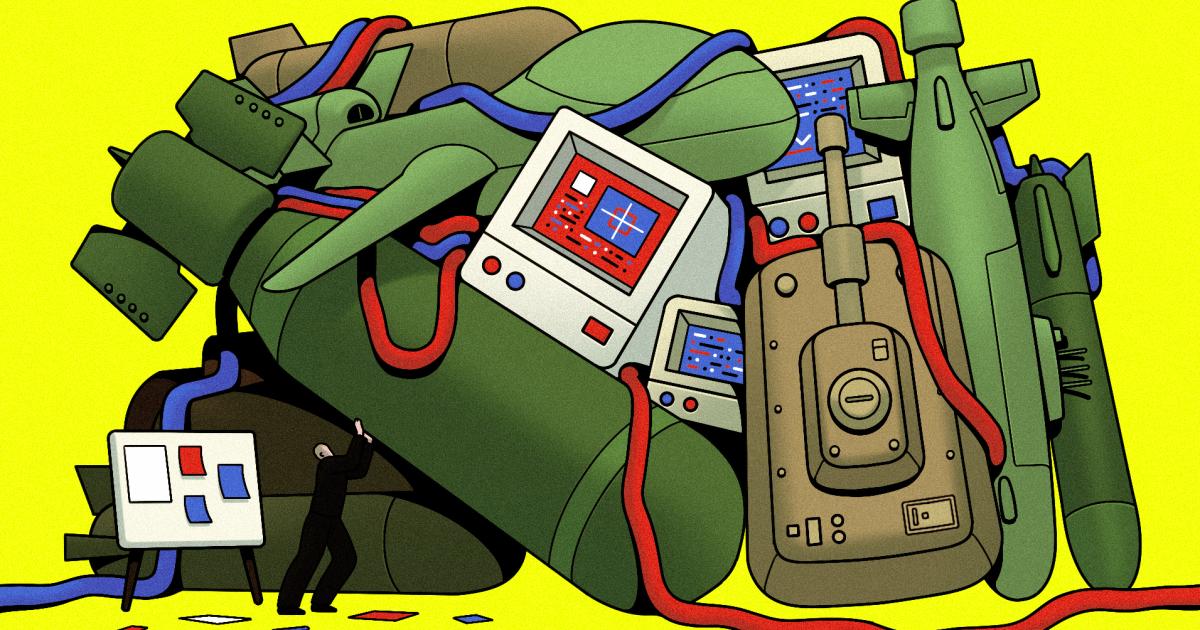
The Fog of Tech
At a time when debates about national security tend to be polarized along partisan and ideological lines, there is one thing analysts and policymakers across the political spectrum seem to agree on: the future of warfare will be determined by technology. Hypersonic missiles, quantum computing, drone swarms, and artificial intelligence have all been hailed as transformative technologies that will shape battlefields, remake strategies, and upend established military doctrines.
Read more The New Energy Stalemate in Ukraine
Without question, these technologies are already having a tremendous impact. In Gaza, Iran, Lebanon, Ukraine, and elsewhere, every party with the capacity to employ artificial intelligence and autonomous systems has done so—in the air, on land, and at sea, and at times in massive numbers. And there is also no question that in order to maintain its status as the world’s preeminent fighting force, the U.S. military must ensure that it has the most sophisticated and cutting-edge capabilities available. To continue developing and operationalizing these technologies, defense planners should prioritize scaling and integrating them and developing innovative operational concepts to employ them. The risk of being overtaken by rivals such as China is real.
But an equally significant risk exists: call it “the technology trap,” in which policymakers develop a misplaced sense of certainty about how innovations will change war and what warfare will look like in the future, while not paying enough attention to the unchanging fundamentals of war. An excessive focus on the role of technology would be shortsighted and lead militaries in dangerous directions, especially if planners are highly confident about how new capabilities will develop and make decisions in line with that confidence—which will almost certainly be misplaced.
For war planners, faith in technological answers can obscure the most fundamental questions: Who kills, who dies, and who decides? In the post–Cold War era, this myopia has contributed to dreadful outcomes in Afghanistan, Iraq, Ukraine, and Gaza. In the decade to come, as U.S.-Chinese tensions persist, the fog of tech could help pave the way for a disastrous great-power war. Policymakers should worry less about getting the right technology at the right time and more about how fixating on technology might make them lose sight of the essential elements of war and find comfort in false certainty.
THROUGH A GLASS, DARKLY
More than 50 years ago, the military historian Michael Howard famously cautioned that future wars are unknowable. “I am tempted indeed to declare dogmatically that whatever doctrine the Armed Forces are working on now, they have got it wrong,” he wrote. “I am also tempted to declare that it does not matter that they have got it wrong. What does matter is their capacity to get it right quickly when the moment arrives.”
But Howard may have been a bit too sanguine about the costs of getting it wrong. For Americans, the paradigmatic example from recent history is how the U.S. military’s technological prowess in the 1990–91 Gulf War seemed to herald a new, high-tech American way of war that would guarantee victory in the post–Cold War era. Instead, Washington slowly and painfully learned that the technological advantages that beat Saddam Hussein’s regime could not defeat insurgencies in Afghanistan and Iraq during the post-9/11 wars.
Predicting the role of technology in future wars has become even harder today thanks to the speed, scale, and complexity of contemporary technological progress. In the past, transformative innovations tended to be expensive at their outset—in resources or personnel—or required specialized knowledge and skills accessible to only a few. Think ofthe combined power of the rifle, the railroad, and the telegraph in the nineteenth century, or fighter jets and nuclear weapons in the twentieth century. By contrast, many of today’s technologies have low barriers to entry: they are cheap to produce, and access to the knowledge necessary to make them has been democratized and globalized. Enemies today often face each other on more equal battlefields, making it trickier for war planners to understand when and for how long new tools will confer an outsize advantage.
In Ukraine, fishermen’s nets are one of the most effective antidrone defenses.
Focusing too much on procuring the shiniest equipment also obscures the ways that high-end technology works in tandemwith more basic tools. In the 2010s, defense planners failed to account for this dynamic when predicting future battlefields, which they believed would be dominated by sophisticated platforms. In 2017, a senior Pentagon official declared that the F-35 stealth fighter would be “a war winner.”The 2018 National Defense Strategy, drafted under the direction of Elbridge Colby, who now serves as undersecretary of defense, anticipated that a few primarily high-end capabilities—including advanced computing, artificial intelligence, robotics, hypersonics, and biotechnology—would “ensure we will be able to fight and win the wars of the future.”
Instead, what emerged were conflicts such as the war in Ukraine, which can be described as World War I meets World War III. Sophisticated Russian ballistic missiles wreak havoc on Ukrainian cities, as do precision-guided glide bombs delivered by fighter aircraft out of the range of air defenses. At the same time, however, highly lethal bombs are dropped by drones carried aloft by simple balloons, and one of the most effective antidrone defenses consists of fishermen’s nets (or similar netting) draped over security checkpoints, critical infrastructure, and, in the case of Izium, an entire small Ukrainian city. A sense of certainty that sophisticated tech would dominate battlefields represented a failure of imagination that has produced real-world consequences: a dozen years ago, few would have predicted that during a U.S.-Israeli war on Iran, cheap Iranian drones would assault soft targets in Gulf Arab states, as they have since February.
THE CENTER OF GRAVITY
An obsession with technology can obscure the precept that war remains a human endeavor. As the military theorist Carl von Clausewitz said almost two centuries ago, “War is not the action of a living force upon a lifeless mass . . . but always the collision of two living forces.” Technology can inadvertently make war appear mechanical and sterile. But the nature of war has not changed. Its language is violence, and technology simply offers new and different ways to communicate. Therefore, the fundamental questions of war remain salient regardless of technological change: What are the ends (particularly with respect to politics), the ways, and the means?
Perhaps the most perilous time for leaders to be distracted by the allure of technology is when considering whether to go to war in the first place.They often mistakenly believe that technology will make doing so less costly in political terms, particularly if they assume innovations will help reduce casualties. A fixation on the tangible and quantifiable advantages technology confers can detract from vital debate and discussion of the broader consequences of resorting to violence. This dynamic likely influenced Russia’s decision to invade Ukraine. Putin and his advisers believed that the Russian military was sufficiently capable thanks to a massive technological reform effort that began in 2009. In the run-up to the 2022 full-scale invasion, Russian Defense Minister Sergei Shoigu proudly claimed that more than 70 percent of Russia’s military had advanced weapons. Within weeks of the invasion, it had become clear this had conferred little advantage on Moscow. The same goes for the U.S.-Israeli attempt to topple the Iranian regime in 2026, a decision shaped in part by the belief that the sophistication of the American military, particularly when compared with its opponent, made success almost inevitable. In the wake of U.S. strikes on Iran’s nuclear sites in 2025, Secretary of Defense Pete Hegseth declared that the attack showed Tehran that Washington’s military capabilities are “nearly unlimited.” In fact, the limits of those capabilities became glaringly obvious when the Iranian regime withstood the 2026 onslaught and even managed to close the Strait of Hormuz.
There are ways to avoid the technology trap. The first is to determine a clear goal before going to war. Planners must develop a theory of victory before a single shot is fired and then steadily put that theory into practice. These critical processes cannot be negated by or outsourced to technology. Before launching the 2026 war on Iran, the Trump administration failed to clearly articulate the operation’s goal, instead offering a shifting set of justifications and rationales and various descriptions of the desired end state. The hope seems to have been that technological wizardry would make it possible to achieve everything on a long wish list without having to prioritize or navigate tradeoffs.
To clarify goals, planners must identify what Clausewitz termed “the center of gravity” of a military operation: “the hub of all power and movement, on which everything depends.” This is where an opponent’s power originates, so it needs to be the focus of a military’s attention and resources. During the 1990–91 Gulf War, the commander of U.S. forces in the Middle East, General Norman Schwarzkopf, identified the center of gravity as Saddam Hussein’s command and control of his military. Accordingly, U.S. strategy focused on impeding Saddam’s ability to communicate with his troops and weakening the Iraqi military’s ability to execute orders—a state of affairs that helped convince Saddam to accept a cease-fire. Without this clarity about where to direct efforts and how to measure their impact, a military will struggle to achieve its ends. Early in the 2003 Iraq war, the U.S. military’s inability to identify the Iraqi population as the center of gravity—that is, failing to understand that the political and military leadership no longer wielded control—resulted in years of devastating losses by encouraging tactics that fomented anti-American sentiment, fueled an insurgency, and made it more difficult to establish a credible and functioning government.
Another way to avoid the technology trap is to conduct deliberate, impartial, and regular reviews of lessons learned during and between wars. Iran closely studied the attacks that Israel and the United States carried out on its nuclear sites in 2025. Recognizing that another war would likely pose an existential risk to the Islamic Republic regime, Iranian security officials engaged in a serious and intense effort to prepare. By devolving command and control at both the political and the military levels during the 2026 war, the regime has survived a lengthy onslaught. U.S. allies are, of course, equally capable of such adaptation. In recent years, NATO’s Joint Analysis and Lessons Learned Centre has maintained a team of researchers dedicated to studying the war in Ukraine, a smart way to institutionalize this task and a potential model to apply to other theaters.
Read more The China Price
ALL FOR ONE, ONE FOR ALL?
The combination of a focus on strategic aims, preparation, and learning remains crucial for effective decision-making in war and cannot be replaced by technology. Similarly, the ways and means of warfare are influenced by technology but have not been fundamentally changed by it. Consider, first, the importance of coalitions and the difficulties of managing them. Going to war exposes the distinct and sometimes even opposing interests, objectives, and perspectives of allies. Planners can devise workarounds when they face disagreements in the heat of conflict, but those may be short-term fixes that mask strategic cleavages.
In early 2026, the United States and Israel launched the war on Iran relying solely on each other. Although the U.S. and Israeli militaries have never operated more closely together in the history of their relationship, their limited success calls into question the partnership’s strategic acumen, despite its remarkable technological capabilities. The two countries notably failed to bring in other partners in the region or in Europe. Early on, several U.S. allies and partners denied the American military access to their territory, bases, and airspace. Although U.S. defense planners have always understood that they might not receive such permissions—Turkey, for example, was unwilling to let the U.S. military invade Iraq from Turkish territory in 2003—the resistance this time was of a different quality and scale. Although most countries ultimately acquiesced, the ones that initially declined threw a wrench into U.S. defense planning, since the American way of war is predicated on an unparalleled global basing network. According to several media reports, Israel found ways around this challenge by setting up a military staging area in Iran during the 2025 war and one in Iraq in 2026. But the ad hoc nature of such creative approaches causes problems for military planning.
As the war has dragged on, the Arab Gulf states have not formally joined the U.S.-Israeli coalition, although at various times during the conflict, Bahrain, Kuwait, Saudi Arabia, and the United Arab Emirates have used military force against Iran. Their willingness to use force was significant in and of itself, but it did not influence the battlefield, despite some of the sophisticated capabilities those countries possess. On the other side, Iran masterfully managed its proxy, the Lebanese militia Hezbollah, pulling it into the conflict and enabling Tehran to project power through relatively unsophisticated technologies such as rockets, mortars, and most notably, cheap drones that Hezbollah repeatedly deployed against Israeli soldiers in Lebanon and Israeli civilians inside Israel. Meanwhile, Russia also helped Iran target U.S. military facilities in the Gulf, resulting in devastating (though not determinative) consequences.
The complexities of coalition maintenance are on display in Europe, as well, where defense planners are wrestling with a security trilemma. First, they must figure out how to incorporate a highly capable and modernized Ukrainian military into continental defense planning. As Germany turbocharges investments in its military, Europe must also contend with a shift in its internal balance of military power—one with uneasy historical echoes. And, incredibly, during the past year, Europeans have had to consider the risk of aggression on the part of the United States, as President Donald Trump mused about securing U.S. control of Greenland. These three realities introduce a host of tradeoffs into European strategy, since prioritizing any one of them would likely make it harder to deal with the other two—and no technology offers a way out.
SAFETY FIRST
Technological determinism can also lead to faulty assumptions about casualties—both civilian and military. Today, target selection is increasingly shaped by artificial intelligence, and strikes are increasingly carried out by autonomous systems. Many have argued that these technological advances will improve targeting and better protect civilians. To date, however, it is unclear whether autonomous systems have delivered on this promise. During the war in Gaza, for example, Israeli military personnel have been able to rapidly approve targets generated by an artificial intelligence system called Lavender. But such systems reflect the rules of engagement set by decision-makers, and after Hamas’s October 7 attack on Israel in 2023, the Israeli military raised the level of civilian casualties it would accept when striking Hamas militants. Perhaps for that reason,researchers who conducted an experiment testing the decision-making of around 2,000 Israeli military personnel found that in hypothetical scenarios involving high levels of collateral damage, they demonstrated “algorithmic aversion” and a desire to rely more on human decision-making.
Ironically, civilians may become more vulnerable, not less, as new technologies make it harder to attack military personnel and targets, increasing the risk of collateral damage and even providing some parties with an incentive to deliberately attack civilians and soft targets. Many militaries, including the American one, increasingly employ technology to minimize the risks borne by their own forces. This desire for immaculate war is not new. Nearly 700,000 U.S. service members participated in the Gulf War in 1990–91, and contrary to expectations of a bloodbath, only 143 of them died, an outcome that bolstered arguments that technology had made it possible to carry out major military operations with minimal risk to American troops. Two years later, the Battle of Mogadishu undercut that view, as the U.S. military withdrew from Somalia after 18 service members died in a protracted fight with Somali militants armed with cheap and relatively low-tech weapons such as rifles, machine guns, and rocket-propelled grenades. Early in the present century, the rapid American overthrow of the Taliban in Afghanistan rekindled the dream of relatively bloodless warfare made possible by innovations. But the grinding fights that followed there and in Iraq once again poured cold water on the idea.
Technological hopes spring eternal, however, and the U.S. military once again seems to be planning operations that use high-tech tools to reduce risks to its personnel.In an operation carried out in Venezuela this past January, that meant employing special operations forces complemented by space-based and cyber platforms and more than 150 aircraft and drones—all to capture a single person, Venezuelan President Nicolás Maduro. In Iran, it has meant waging a war to transform conditions on the ground, but with attacks carried out primarily from the air and by sea.
To be sure, this approach is linked to the fact that the United States is not engaged in existential wars. And when the U.S. military has fought an adversary that perceives the conflict as existential, as in the Iranian case, American officials are often surprised that their adversaries refuse to back down and are willing to absorb staggering losses. Even if technology allows for fewer American casualties, that does not mean it should short-circuit robust political debate about whether to go to war. Casualties, after all, are hardly the only cost that contemporary warfare can impose. Even wars that produce relatively low casualties can destroy economies, bring down governments, and rip apart societies.
BACK TO BASICS
Countries that haven’t waged war in many decades, such as China, may be even more susceptible than the United States to the technology trap. Such countries might focus on acquiring innovative tools rather than preparing for adversaries that know how to integrate new technologies at scale. This may present some opportunities for Washington given its substantial recent experience in formulating concepts of operation tied to technological advancements. But countries such as China might be no less confident about their capabilities, even though they are significantly less experienced, which means the risks of miscalculation and escalation could easily increase.
Deep faith in new technologies could result in much smaller militaries, as machines replace human personnel. In the United States, this shift could widen the gap that already exists between ordinary Americans and those who serve, as even fewer Americans will have connections to—and therefore care about—how, when, where, and why Washington resorts to military force. This detachment of the military from the society it serves is corrosive to the institution itself and to democracy more broadly since it undermines the principle that war-making should reflect the will of the people. Countries that rely on conscription won’t face quite the same problem, but technological determinism will affect their relationships with their publics, as well: even if such countries need fewer citizens to serve, the technology trap could still reduce social cohesion by further marginalizing the sectors of society from which conscripts tend to be drawn.
Perhaps the most pernicious effect of the technology trap might be the way it could hollow out deterrence, as policymakers are tempted to adopt a myopic approach to the use of force shaped by deterministic views of technology’s impact on the battlefield. Deterrence requires an adversary to cogently read signals regarding capability and will. If both parties in a conflict have confidence in their own capabilities and in those of the other side, they may face increasing pressure to outdo each other in demonstrating a greater will to fight.Such a dynamic could result in a dangerous escalation spiral, particularly if it is paired with assumptions that technology will minimize the role and responsibilities of humans.
It is possible to escape the fog of tech. The most important thing for strategists and officials to grasp is that even though the means of warfighting will keep changing, the fundamental nature of war will not. There is not, and will never be, a shortcut—technological or otherwise—to answering the hard questions one must confront before sending troops to fight, kill, and die.
Read more What India’s Protests Reveal About the Future of Liberalism

Related Posts
The New Energy Stalemate in Ukraine
A Less-Is-More Strategy for America